 Oct, 23 2025
Credit Utilization Calculator
Optimize Your Credit Utilization
The article shows that keeping utilization below 20% is critical for reaching a 900 score. Calculate your current utilization to see if you're in the optimal range.
When people hear the magic number 900 credit score, they wonder if it’s a myth or a realistic goal. In Australia, the top of the FICO‑style scale sits at 900, and while it’s rare, hitting that mark isn’t impossible. This guide walks you through what a 900 score means, how the scoring models work, and the exact steps you can take to push your rating into the elite zone.
Key Takeaways
- A 900 credit score sits at the very top of the 300‑900 scale used by most Australian scoring models.
- Only about 1‑2 % of consumers in Australia ever reach 900, but the gap between 800 and 900 is often a matter of fine‑tuning a few credit habits.
- Focus on payment history, credit utilization, and age of credit lines - those three pillars account for roughly 70 % of your score.
- Regularly monitoring your credit file with the three main bureaus (Equifax, Experian, Illion) helps you spot errors that can cost points.
- Strategic moves like keeping old cards open, limiting hard inquiries, and diversifying credit types can shave off the last handful of points needed for 900.
What Exactly Is a Credit Score?
Credit Score is a numeric representation of your creditworthiness, calculated from data in your credit file. In Australia, the most common scoring range runs from 300 (poor) to 900 (excellent). Lenders use this number to decide whether to approve you for a credit card, personal loan, or mortgage, and at what interest rate.
How the 300‑900 Scale Works
Two major scoring models dominate the Australian market:
- FICO Score (often referred to as the FICO‑based model) - a proprietary algorithm used by many big banks.
- VantageScore - a competing model adopted by several fintech lenders.
Both models evaluate similar data points but weight them slightly differently. The table below highlights the key similarities and differences.
| Factor | FICO Weight | VantageScore Weight |
|---|---|---|
| Payment History | 35 % | 40 % |
| Credit Utilisation | 30 % | 20 % |
| Length of Credit History | 15 % | 15 % |
| Credit Mix (cards, loans, mortgage) | 10 % | 10 % |
| New Credit / Hard Inquiries | 10 % | 15 % |
Is a 900 Score Realistic?
Statistically, only about 1‑2 % of Australian consumers ever hit the 900 mark. That tiny slice represents people who consistently excel across all five pillars listed above. However, the chasm between an 800‑850 score and a perfect 900 is often just a handful of points-usually tied to minor nuances like a single late payment a few years ago or an occasional hard inquiry.
In other words, while the goal is elite, it’s not a fantasy. By tightening a few credit habits, you can push a solid 800 into the 900 zone.

Five Core Pillars That Decide Your Score
Below are the five data categories that drive both FICO and VantageScore calculations. Each pillar includes a brief explanation and a practical tip to maximise points.
- Payment History - Tracks whether you pay on time. Late payments, defaults, and bankruptcies heavily scar your score. Tip: Set up automatic payments for at least the minimum due on every account.
- Credit Utilisation - The ratio of outstanding balances to total credit limits. Lower ratios (under 30 %) are prized. Tip: Keep balances below 20 % of your limits; consider a credit limit increase without increasing spend.
- Length of Credit History - How long your accounts have been open. Older accounts contribute positively. Tip: Never close your oldest credit card, even if you rarely use it.
- Credit Mix - Variety of credit types (credit cards, personal loans, mortgage). A balanced mix signals responsible handling of different debts. Tip: If you only have credit cards, a small personal loan can improve the mix.
- New Credit / Hard Inquiries - Each time you apply for credit, a hard inquiry is recorded. Too many in a short period can drop points. Tip: Space out credit applications by at least six months.
Step‑by‑Step Blueprint to Reach 900
- Pull Your Full Credit Report from the three bureaus - Equifax, Experian, and Illion. Look for errors such as wrong balances or mis‑dated accounts.
- Dispute any inaccuracies via the bureau’s online portal; corrections can instantly boost your score by 10‑30 points.
- Eliminate Late Payments
- If you have any “late” marks older than 30 days, contact the creditor. Some lenders will remove a one‑time late payment as a goodwill gesture.
- Trim Credit Utilisation Below 20 %
- Pay down existing balances aggressively.
- Request a credit limit raise on cards you use responsibly. The higher the limit, the lower the utilization ratio.
- Preserve Account Age
- Keep your oldest cards open, even if you move to a newer premium card.
- Consider converting a low‑usage card to a “no‑annual‑fee” version rather than closing it.
- Mix Credit Types Wisely
- If you only have revolving credit, a small unsecured personal loan (e.g., AU$2,000) can improve the mix without adding much risk.
- Limit Hard Inquiries
- Use “soft” pre‑approval checks when shopping for credit cards; they don’t affect your score.
- Only submit a full application when you’re confident about approval.
- Maintain a Low Debt‑to‑Income Ratio
- Lenders like to see this ratio below 30 %.
- Boost your income (e.g., freelance work) or reduce debt to improve the metric, which indirectly influences scoring models that incorporate risk assessments.
- Stay Consistently Active
- Use each credit card at least once a month and pay it off in full.
- Periodic activity prevents the account from being flagged as “inactive,” which can slowly erode its positive impact.
Following this checklist and revisiting it quarterly will typically raise any score above 800 into the 900 territory within 12‑18 months, assuming no major setbacks.
Common Pitfalls That Stall Your Progress
- Closing Old Accounts - This instantly reduces your average account age and can spike utilization.
- Carrying Balances on Multiple Cards - Even if each card stays under 30 %, the combined utilization might still be high.
- Ignoring Small Errors - A mis‑recorded $0 balance as $500 can shave off 15‑20 points.
- Frequent Hard Pulls - Applying for several credit cards in a short window looks risky to lenders.
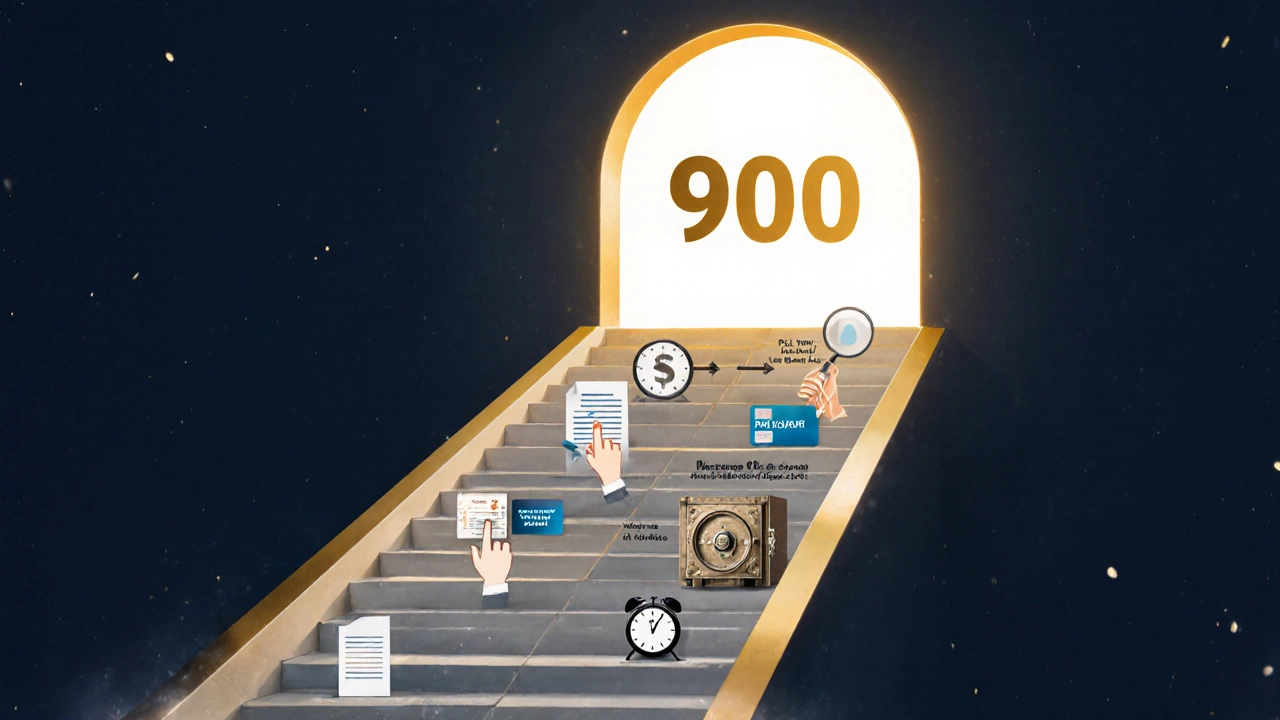
How Long Does It Take?
Improving from a solid 750 to 900 generally requires 6‑12 months of flawless behaviour. If you have recent negative marks (e.g., a 60‑day late payment), expect a 12‑24‑month recovery period, because older negatives lose weight over time.
Quick FAQ
What is the highest possible credit score in Australia?
Both FICO and VantageScore models cap at 900. A 900 score means you have an impeccable payment history, very low utilization, long credit history, diverse credit mix, and few recent inquiries.
Can I get a 900 score with only one credit card?
It’s extremely unlikely. The credit‑mix factor rewards having at least two types of credit (e.g., a credit card and a small personal loan). Without mix, the score usually caps in the high‑800s.
How often should I check my credit report?
At least once every six months. Many banks now offer free quarterly checks; use them to spot errors early.
Do hard inquiries stay on my report forever?
Hard inquiries remain for two years, but only the most recent 12 months affect the scoring algorithm.
Is it worth paying off a $0‑balance credit card to improve my score?
No. A $0 balance is already ideal for utilization. Instead, focus on keeping the card open to preserve its age.
Final Thoughts
Achieving a 900 credit score isn’t reserved for finance wizards; it’s a disciplined refinement of the basics. By cleaning up errors, maintaining ultra‑low utilization, protecting the age of your accounts, diversifying your credit types, and limiting new hard pulls, you can climb from a strong 800 into the elite 900 range. Remember to monitor your file regularly and adjust your strategy as life events-like a new loan or a change in income-occur. With steady effort, that perfect score moves from a distant dream to a realistic milestone.